



HOW TO: Choose the Best Work Surface for Your Laboratory
The best laboratory work surface depends on what happens on the bench. Chemical exposure, heat, moisture, cleaning requirements, equipment weight, abrasion, impact, and the need for contamination control should all be considered before selecting a material.
There is no single work surface that is best for every laboratory. Epoxy resin is often selected for demanding chemical and heat applications, phenolic resin works well for many instrumentation and wet-lab environments, stainless steel is valued where cleanability is a priority, and laminate can be a practical choice for general laboratory work with lighter chemical exposure.
The SEFA 3-2020 Laboratory Work Surfaces Standard identifies performance criteria that laboratories should consider when selecting a surface, including chemical and stain resistance, abrasion and scratch resistance, ease of cleaning, heat and cold resistance, impact resistance, load-bearing capability, bacterial resistance, and water absorption. (Source)
Which Laboratory Work Surface Is Best for Your Application?
A useful starting point is to match the material to the primary demands of the laboratory.
| Work surface | Often a good fit for | Important considerations |
|---|---|---|
| Stainless steel | Labs where cleaning, sanitation, and moisture resistance are priorities | Can scratch; alloy grade and finish should match the application |
| Ceramic | Applications requiring a hard, nonporous surface with strong stain and scratch resistance | Hard but more brittle than many resin-based materials |
| Solid surface | General laboratory areas needing a smooth, nonporous and repairable surface | Chemical and heat resistance vary by formulation |
| Epoxy resin | Harsh chemical use, high heat, and demanding laboratory environments | Heavy and generally more costly than basic laminate surfaces |
| Phenolic resin | Instrumentation, diagnostics, wet labs, and many general research applications | Application-specific chemical and heat requirements should be reviewed |
| High-pressure laminate | General-purpose laboratories with moderate demands and budget considerations | Not the best choice for frequent harsh chemical, high-heat, or prolonged moisture exposure |
The final decision should always be based on the actual chemicals, temperatures, cleaning products, equipment, and processes used in the lab. SEFA specifically recommends evaluating chemical resistance under conditions representative of the actual laboratory because performance can be affected by concentration, exposure time, temperature, humidity, and housekeeping practices.
What Should You Consider When Choosing a Laboratory Work Surface?
Start with the work being performed, not with the material name.
Before specifying a laboratory countertop or workbench top, identify:
- Chemicals and reagents that may contact the surface
- Expected heat, cold, or rapid temperature changes
- Frequency and type of cleaning or disinfection
- Water and moisture exposure
- Weight and stability requirements for instruments
- Potential for scratches, abrasion, or impact
- Contamination-control requirements
- Whether the workstation may need to move or be reconfigured
- Budget and expected service life
For laboratories working with pathogens, radioactive isotopes, or other processes requiring stringent decontamination, SEFA notes that nonporous materials and smooth surfaces may be required.
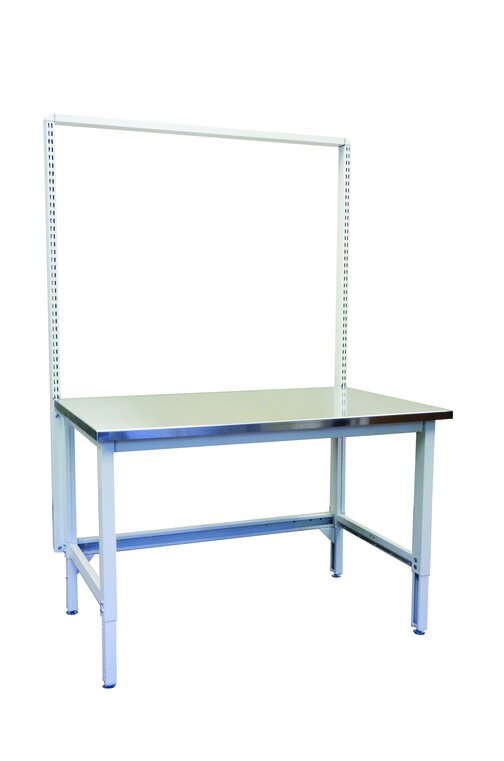
Stainless Steel Laboratory Work Surfaces
Stainless steel is a strong choice when cleanability, moisture resistance, durability, and sanitation are major priorities.
Laboratory stainless steel work surfaces are commonly fabricated from 304 or 316 series stainless steel. SEFA describes laboratory stainless steel tops and sinks as typically using 14- to 18-gauge 304 or 316 series material, with welded seams ground smooth and blended to the finish. (Source)
The difference between 304 and 316 is based on alloy composition and corrosion performance, so the appropriate grade should be selected according to the chemicals and environmental conditions in the laboratory rather than simply assuming that a higher grade number is always better.
Advantages of stainless steel
Stainless steel provides a smooth, durable surface that can tolerate frequent cleaning and is particularly useful where sanitation and resistance to moisture are important. Treston commonly recommends stainless steel for applications where cleanability and disinfectant use are major considerations.
What to consider
Stainless steel can scratch, and different finishes may perform differently in cleaning and appearance. Chemical exposure should also be reviewed because stainless steel is corrosion resistant, not completely corrosion proof.
Best suited for: clean laboratory environments, pharmaceutical and medical applications, washdown-prone areas, and other spaces where frequent cleaning is essential.
Ceramic Laboratory Work Surfaces
Ceramic provides a hard, smooth and nonporous surface that can perform well where stain resistance, scratch resistance, and easy cleaning are important.
Ceramic work surfaces can be a good option for laboratory applications requiring a durable, sealed surface. Because the material is very hard, it resists routine scratching and does not require the same type of surface sealing as many natural materials.
Its primary tradeoff is brittleness. A ceramic surface can be more vulnerable to chipping or damage from severe impact than phenolic, laminate, or some resin-based alternatives.
Best suited for: laboratories seeking a hard, nonporous surface where chemical, stain, and scratch resistance are important and severe impact is unlikely.
Solid-Surface Laboratory Countertops
Solid-surface materials provide a smooth, nonporous and often seamless work area that can be shaped and repaired more easily than many harder laboratory surfaces.
SEFA defines solid-surface materials as composites made from natural minerals and acrylic, polyester, or epoxy resins. The material is homogeneous throughout, nonporous, and may be fabricated with inconspicuous seams. (Source)
That makes solid surface useful where appearance, cleanability, and seamless fabrication are priorities.
However, performance varies significantly by product formulation. Chemical resistance, heat resistance, scratching, and staining should be checked against the manufacturer's technical data before specifying a solid-surface material for demanding laboratory use.
Best suited for: general research, educational, clinical, and support areas where smooth fabrication and easy cleaning are more important than extreme chemical or heat resistance.
Epoxy Resin Laboratory Work Surfaces
Epoxy resin is commonly selected for demanding laboratories where resistance to chemicals, moisture, and heat is a priority.
SEFA describes epoxy resin laboratory tops as a homogeneous, non-absorbent composite of epoxy resin, silica, inert fillers, and organic hardeners. (Source)
Treston has traditionally recommended epoxy resin for laboratory applications involving harsh chemicals or elevated heat.
Because of its durability and resistance characteristics, epoxy has long been associated with chemistry, research, testing, and other demanding laboratory environments.
What to consider
Epoxy is relatively heavy, and the specific formulation still needs to be evaluated against the chemicals and temperatures used in the laboratory. Rapid temperature changes can also be an important consideration, so users should confirm manufacturer limits for extreme hot or cold exposure.
Best suited for: chemistry labs, research laboratories, testing environments, and applications involving frequent chemical exposure or elevated temperatures.
Phenolic Resin Laboratory Work Surfaces
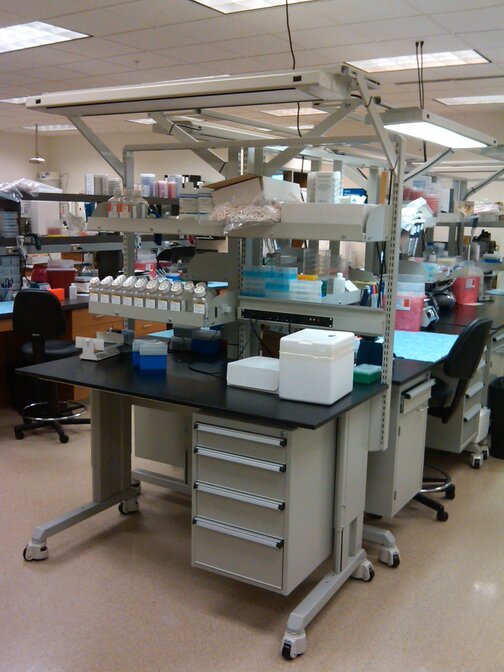
Phenolic resin offers a strong balance of chemical resistance, moisture resistance, durability, cleanability, and relatively low weight, making it a versatile choice for many laboratories.
SEFA describes solid phenolic composite as a compression-molded material with an organic-fiber-reinforced phenolic core and one or more integrally cured surfaces that may be nonporous.
Treston commonly recommends phenolic surfaces for instrumentation laboratories, diagnostic environments, wet applications, and other general laboratory uses.
Phenolic's combination of durability and lower weight can also be valuable for flexible or reconfigurable laboratory workstations, where furniture may need to be moved or adapted as workflows change.
What to consider
Chemical, temperature, and fire-performance requirements should always be checked for the specific phenolic product being specified. No laboratory material should be assumed to resist every reagent or process condition.
Best suited for: instrumentation, diagnostics, pharmaceutical R&D, wet labs, general research, and flexible laboratory environments.
High-Pressure Laminate Laboratory Work Surfaces
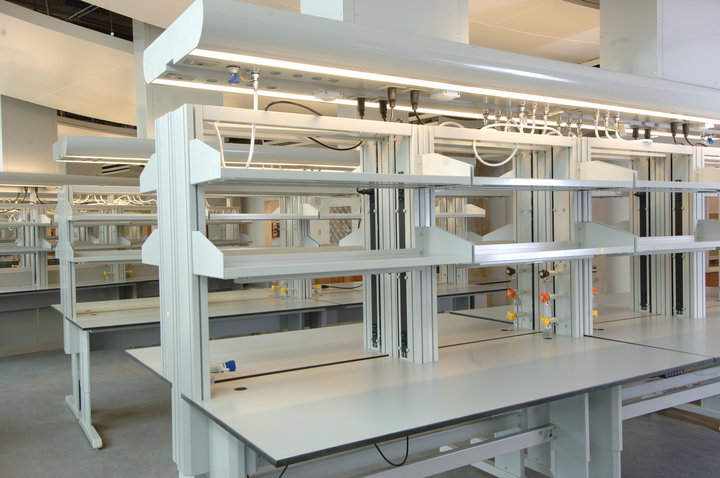
High-pressure laminate can provide an economical and easy-to-clean surface for general laboratory applications that do not require extreme chemical, heat, or moisture resistance.
SEFA describes high-pressure plastic laminate as layers of melamine-impregnated surface paper pressed over phenolic-impregnated kraft paper and bonded to an appropriate substrate. (Source)
It is important to distinguish ordinary decorative laminate from laboratory-grade, chemical-resistant laminate. For example, Wilsonart manufactures laboratory-grade compact laminate specifically engineered to resist a range of acids, solvents, reagents, cleaning agents, stains, and impacts. (Source)
This is why the material specification matters just as much as the general material category.
What to consider
Edges, seams, substrate construction, and prolonged moisture exposure deserve particular attention. For labs using aggressive chemicals, high heat, or frequent washdown, another material may provide better long-term performance.
Best suited for: educational labs, light-duty testing, general research, offices within laboratory environments, and other applications with moderate exposure requirements.
How Do Laboratory Work Surfaces Compare?
The right material is the one that best matches the laboratory's actual risk and performance requirements, not necessarily the most expensive surface.
SEFA's work-surface guidance reinforces this approach. Selection should consider the specific chemicals used, likelihood of scratching or impact, cleaning requirements, temperature exposure, load, moisture, and contamination-control needs. SEFA also recommends obtaining manufacturer performance data and, where appropriate, evaluating samples before specifying a material. (Source)
For example, a general instrumentation lab may not need the same surface as a chemistry lab handling aggressive reagents. Likewise, a highly flexible R&D lab may place additional value on a durable but lighter surface that can move with a modular workstation.
What Work Surface Options Does Treston Offer?
Treston offers multiple laboratory work-surface options so the bench can be matched to the work rather than forcing every laboratory into one material.
Current Treston laboratory configurations include phenolic and laminate work surfaces, while additional options such as epoxy and stainless steel are available for applicable workstation configurations and projects. Treston's Concept Ergo laboratory benches, for example, are offered with laminate or black phenolic work surfaces in the U.S. laboratory catalog.
Work-surface selection can also be considered as part of the complete workstation design, including:
- Required bench size and load capacity
- Fixed or height-adjustable frames
- Instrument and equipment placement
- Shelving and storage
- Utilities and power
- Cleanability and process requirements
- Future reconfiguration
That is especially important in a flexible laboratory. The work surface should support today's process while the workstation itself remains adaptable to future equipment, workflow, and staffing changes.
How Do You Choose the Right Laboratory Work Surface?
Define the process first, compare each material against the laboratory's actual requirements, and then select the surface that provides the best combination of chemical resistance, cleanability, durability, ergonomics, flexibility, and cost for that application.
There is no universal “best” laboratory countertop. The best choice for a chemistry lab may be very different from the best choice for an instrumentation, pharmaceutical, diagnostic, educational, or general research laboratory.
Treston's laboratory specialists can help evaluate the application, workstation configuration, equipment, workflow, and work-surface requirements together rather than treating the countertop as a separate decision.
Explore Treston Laboratory Furniture
Design a Laboratory Workstation with Treston's 3D Configurator
Contact a Treston Laboratory Specialist


Designing Functional and Inspiring Laboratories: A Guide to Lab Furniture for Architects
As an architect, you play a crucial role in creating spaces that are not only aesthetically pleasing but also highly functional. When it comes to designing laboratories, the choice of furniture is paramount. Lab furniture not only needs to provide a safe and efficient working environment but also enhance productivity and promote innovation. In this blog post, we will explore the key considerations architects should keep in mind when selecting lab furniture, and highlight some innovative solutions that can transform a mundane laboratory into an inspiring hub of scientific discovery.
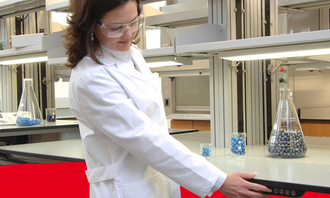
Unlocking Success in Lab Design: 8 Essential Keys to Choosing the Perfect Lab Furniture
If you're tasked with designing a modern lab space that enhances productivity and efficiency, look no further than Treston's lab furniture solutions. Our products are specifically designed to meet the unique needs of modern laboratories, providing a seamless blend of functionality, flexibility, and ergonomic design.
